Panspermia: Could we all be aliens to this world we know?
On the origins of life beyond Earth and the hypothesis of panspermia
By Graham Lau
Originally published on The Cosmobiologist
We don’t know how life began on Earth. We may never know.
The Earth itself is constantly reworked through volcanism, erosion, weathering, and subduction. Most surface materials are geologically young, in the range of thousands or millions of years old. To find the oldest rocks on Earth, we have to travel to the cratons of Greenland, South Africa, and Western Australia, where we can find formations well over 3 billion years old. But even these ancient bastions of the chemical fingerprints of Earth’s processes aren’t old enough. Almost none of them reach back over 4 billion years old (and the few that might are still being debated today). We have zircon mineral grains from that deep time that hint at early Earth chemistry, but (most of) the actual rocks, the landscapes, the tidal pools or geothermal settings where life might have sparked—those are gone, beaten and weathered and worked into new rocks or subducted into the planet’s churning interior to be recycled.
The geological record of life’s beginnings on Earth has been erased.
As I’ve often shared: maybe the only way we’ll ever know for sure how life started here is if some advanced alien civilization was watching, took notes, and someday shows us the data. “Hey,” they might say, “we have your baby pictures!”
But what if life didn’t start here?
What if it just seems like life happened here at some point long ago, but those earliest signals of life are actually what we have left from a time when life on our own planet was seeded by living things or biological materials from outside?
This idea is called panspermia—literally from the Ancient Greek for “seeds everywhere.”
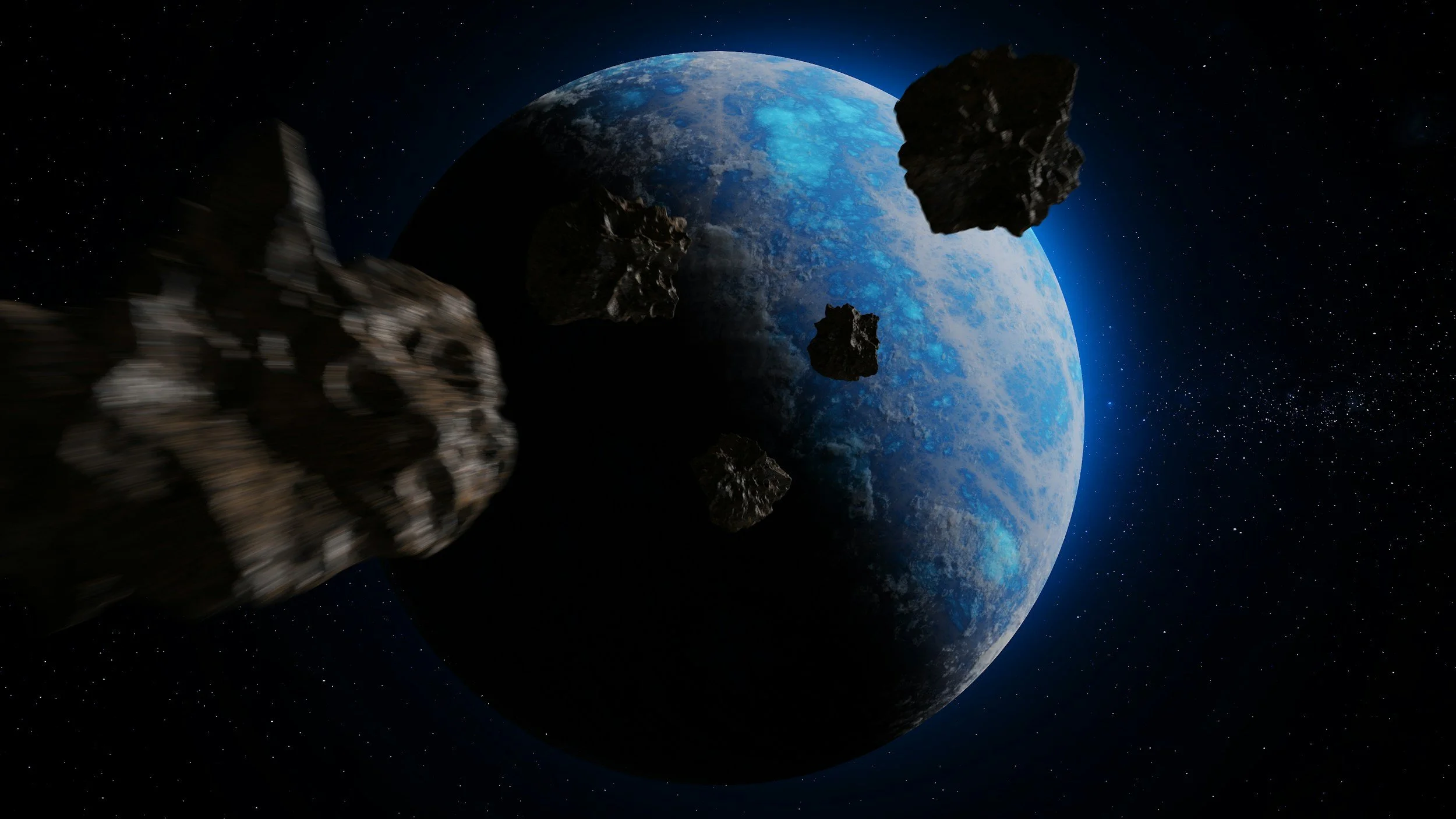
Panspermia has long been one of the more fascinating ideas in astrobiology for me. It suggests that maybe life started elsewhere, perhaps on Venus or on Mars or even much further away in some other star system long ago, and then traveled here, perhaps within a rock like an asteroid or comet, and then crashed to Earth with the life or life-initiating materials on-board.
Panspermia clearly isn’t an origins of life concept. It doesn’t answer the question of how life began (and anyone proffering panspermia as acceptable must still consider the need for origins). But it does attempt to frame an understanding of life on our own world as potentially connected to more life “out there.”
BMSIS Visiting Scholar and astrobiologist, Jessica Xhumari, recently helped to research and provide scientific analysis for a new video from MelodySheep on YouTube that explores this concept of panspermia in a fun way. Check it out!
A Journey from Hell
The video argues that Mars, smaller and quicker to cool, formed flowing water and a solid crust 100 million years before Earth did—giving the Red Planet a crucial head start in the race to spark life.
I find all of the newer evidence on Mars’ early history over the past couple of decades to be compelling. In 1980, when Carl Sagan published Cosmos, Mars seemed for sure to have been probably lifeless, cold, and arid for its history, with only some faint glimmers of possible early works of water (like the orbital images from Viking showing valleys and deltas). We now have ample evidence that Mars’ early years were much different, with a more clement environment for life and lots of water available. Maybe Mars really could have had life (maybe there is even life there now!).
I’m personally not as compelled by the findings in Jezero Crater thus far. The Cheyava Falls rock is super intriguing, but I personally think our best bets for finding life, past or present, on Mars are going to be with samples collected at depth. The surface environment of Mars has been unfriendly for life as well as for the preservation of life’s signatures for quite some time. I could be wrong, but I think if Mars ever had life then to find it we need to get some better drilling infrastructure there.
I think if there were any other world in the early solar system that may have had life, it was most likely Venus. We’re still learning a lot about Venus and so much is missing, due in large part to how Venus itself has changed through time, but if early Venus could have had liquid waters and perhaps oceans and maybe a more clement environment at the surface for life, then maybe life started there long before it did on Earth or maybe on Mars.
If panspermia could have happened in our solar system, then we might be Venusian or Martian in inheritance. If we ever find some diagnostic signs of life from Venus or Mars and we happen to learn that such life is bewilderingly similar to our own (down to the same biomolecules, the same information and metabolic systems, and even the same genetic code structure), that could tell us something really did happen that led to us being connected but cosmically separated.
Some have also argued that maybe a panspermian process for life as we know it brought alien life from far away and long ago here to Earth. Maybe we have origins so distant that we’ll only ever know if we find someone else “out there” who shares so much in common with us that it would be exceptionally improbable for us to have had separate origins.
For panspermia to work, life must survive what the video calls “the gauntlet: a three-stage journey from hell”. First, living things would need to survive being launched into space several times faster than a speeding bullet inside superheated rock fragments. Second, they’d need to endure the long journey through the frozen vacuum of space, devoid of water or nutrients, potentially for millions of years, all while being bombarded by radiation (that’s why being inside of a rock is a safe bet for it being possible). Finally, the life or biological materials would need to withstand the re-entry to a new world (materials inside of meteorites stay relatively cold, but any living things deep inside the rock would also need a way to then get out upon arrival).
“Life,” as the video shares the quote from Ian Malcom (Jeff Goldblum) in Jurassic Park, “uh, finds a way.”

The gauntlet is survivable. Various researchers over the past few decades have conducted experiments to show that panspermia “could” be possible (the fact remains that no one has conclusively shown that it has happened).
Why Panspermia Matters
Panspermia doesn’t answer the question of how life began. But it does offer some new locations for origins to occur.
While I personally believe that life most likely started here (though I also speculate that origins can occur in multiple different pathways and are common across the cosmos), there are some issues with origins of life on Earth.
Steve Benner, many years ago now, pointed out that the early Martian environment may have been more favorable for the formation of RNA (and then DNA) than the early Earth. And while many researchers have long thought that life, if it started on Earth, started deep in the oceans around hydrothermal vents, we face the issue of how compartmentalization and bringing together the necessary materials to make life can happen in an environment with so much dilution from water. That’s led Bruce Damer and Dave Deamer to their modern idea called the Hot Spring Hypothesis. They suggest that life would be more likely to start on Earth around geothermal spring settings where wetting and drying cycles could help drive the processes of forming biomolecules and driving reactions. But how many hot springs were available on the early Earth? We don’t really know the answer to that yet (there’s still some debate on when above water landmass formed, but it’s pretty well reasoned that much of the Earth surface was covered in water with the oceans in the timeframe when life was likely to have started here). All of this is pretty intriguing for arguments that maybe life started on Venus or Mars. None of it guarantees that, but it should at least give us good reason for deeper discussion of what we know and what we don’t know.
But honestly the more intriguing thing about panspermia is what it suggests about life in general in the cosmos. If panspermia can happen (seems probable) and has happened (we have no certainty on that yet) then it could mean that life on multiple biospheres can share origins and evolve along similar lines. It could mean that life can start on worlds with more favorable environments for origins and then migrate to other worlds where it might now have started on its own but could adapt to new niches and begin thriving and evolving.
If life can transfer between worlds, then biology isn’t confined to isolated planetary experiments. The cosmos becomes a connected web where life, once sparked anywhere, can spread. And there’s something poetic in that.
Keeping Our Feet on the Ground
As with all fanciful ideas, we need to be careful. The history of panspermia includes legitimate science, speculative overreach, and some outright pseudoscience.
The idea that space contains organic material has solid foundations. When the Orgueil meteorite fell in France in 1864, chemist François Stanislaus Clöez analyzed it and noted content that “would seem to indicate the existence of organized substances in celestial bodies.” This sparked intense debate, especially given the timing—Pasteur was simultaneously disproving spontaneous generation on Earth, making the question of whether such generation might occur elsewhere especially provocative. While life was never found in those early studies, we now know that many meteorites on Earth as well as samples from objects in space show signs of a wide range of organic molecules forming naturally.
Researchers have now shown a wide range of organic molecules, including amino acids, in meteorites like Allende and Murchison, and recently researchers like Danny Glavin have shown that rock samples returned from the asteroid Bennu include a range of organics. Glavin and colleagues also reported on finding all five of the nucleobases that we use in RNA and DNA on Earth!
We now know that organic molecules are ubiquitous in space.
It’s important to note, though, that these findings are only preliminary pieces of a much larger puzzle. Some people have read about these findings and then suggested unsupportable conclusions. But the nucleobases of RNA and DNA are not RNA and DNA themselves, and finding these nucleobases is not itself confirmation that panspermia has happened.
A nucleobase is the nitrogen containing ring structure that forms a part of an RNA/DNA base. When a nucleobase is chemically bonded to a ribose sugar, it becomes a nucleoside (none of which have been found beyond Earth). And then when a nucleoside is bonded to a phosphate molecule that forms that backbone of RNA/DNA it becomes a nucleotide (none of which have been found beyond Earth). And when these nucleotides bind together with a phosphate backbone they can become single strands of RNA or DNA, and even be paired together in various structures and double strands through other bonds (and no RNA nor DNA has been found beyond Earth, outside of the bits from Earth on the ISS). There have been no findings so far from samples of meteorites or asteroids that have shown how a prebiotic environment in space can overcome the issues involved in chemically going from nucleobase to nucleoside to nucleotide to full RNA/DNA molecule.
This is why it can be frustrating when many of us in the realm of astrobiology see people taking amazing findings that could be supportive of various possibilities for life out there and then making the logically unsupportable leaps to go from “could be” to “oh, it definitely is.” And, worse, some of the people who make those jumps can become so ensconced in their belief that it must be real that they take to logical fallacies, name calling, and even harassment when others don’t share their certainty.
A well grounded conversation about panspermia, much like those about the possibilities for life’s origins, should explore what we know and what we don’t know while considering what is possible (and maybe allowing for a fun dose of imagination!).
The Question Remains Open
Panspermia forces us to think beyond the immediate. It could be possible, and that alone says a lot to us about the potential for life’s origins as well as the distribution of life in the cosmos.
Much as with determining how life started here on Earth, if it started here on Earth, we may never have definitive proof that life as we know it came here through a process of panspermia.
The geological record from early Earth is too fragmentary and the chemistry too ambiguous.
But I would argue that if we someday find some definitive signs of life from Venus or Mars, elsewhere in our solar system, or maybe even from far away, and we should also discover that it shares a reasonable amount of chemical and biological similarity with us, then we might be able to conclude a shared origin. The funny thing is, though, in some of those cases it might be that life started on Earth and then traveled to this other place. It could be rather than us being the aliens who got here from the outside that we shed some life early on that led to us having some celestial cousins on Mars or elsewhere.
A lot of people have a hard time sitting with scientific uncertainty. Many of those around us want definitive answers, and judge others harshly when they’re unwilling to take a staunch position on a certain matter. But there are some things we just don’t know yet and maybe never will. There are things we know and have learned through millennia of experiment and observation, speculation and discovery, but we are only just beginning as a species coming to understand its place in the cosmos (at least, I hope that’s the case, and that we don’t wipe ourselves out before we get to learn more). The origins of life on Earth as well as whether panspermia has ever happened are things we just don’t know (yet).
But entertaining the possibilities and asking profound questions connects us to something larger than ourselves. And, in astrobiology like in most fields of human study, sometimes the most profound insights come not from answering questions, but from learning to ask them in ways that reveal how much we still have to discover.
This piece was originally published on The Cosmobiologist. You can check out more of Dr. Lau’s writing over there.