Astrobiology Revealed #30: Lena Daumann and Jonathan Gutenthaler-Tietze
on the potential role of rare earth elements in prebiotic chemistry
by Aubrey Zerkle
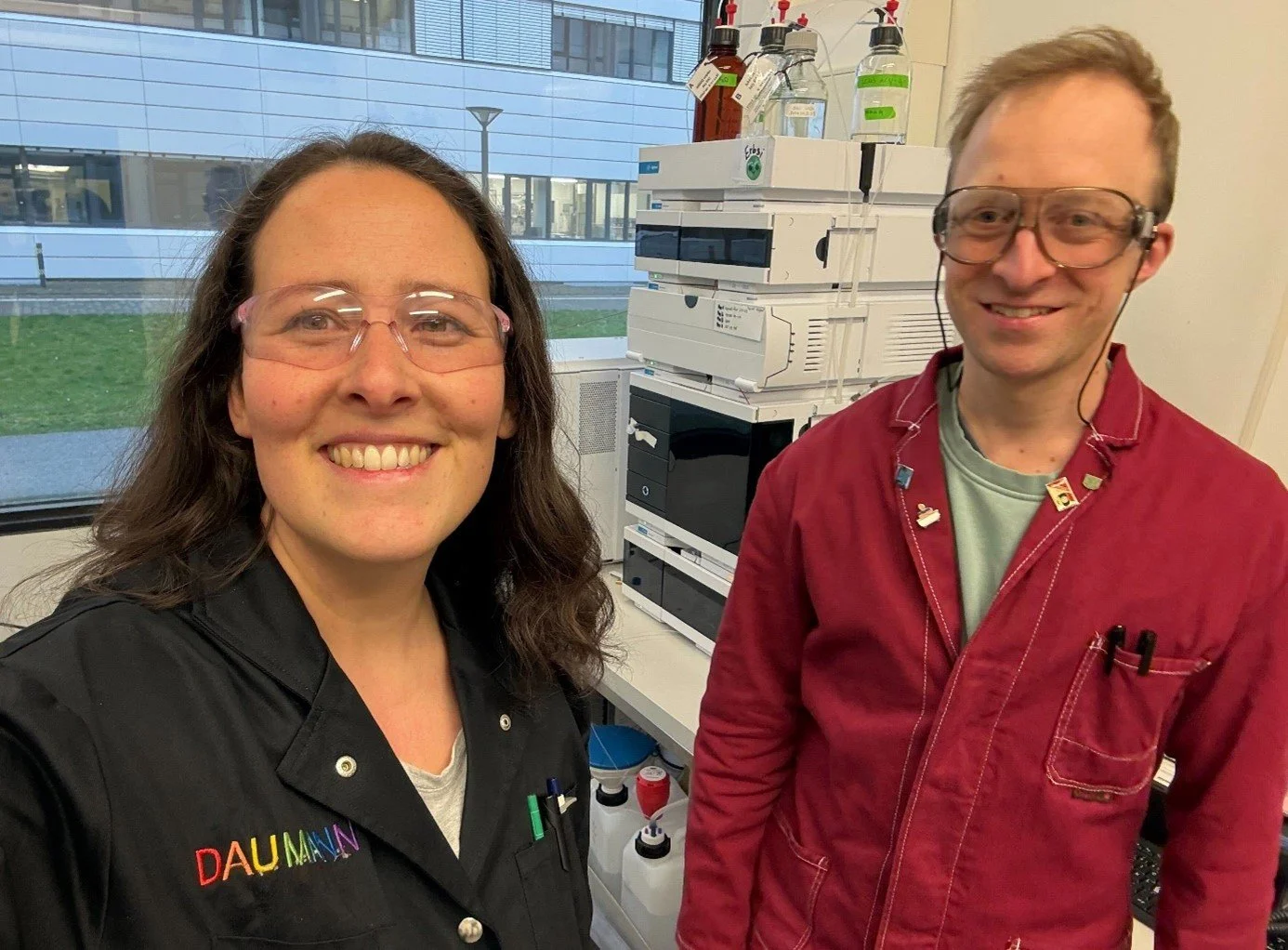
In this Q&A, we asked Lena Daumann and Jonathan Gutenthaler-Tietze about their recent paper, “Influence of Rare Earth Elements on Prebiotic Reaction Networks Resembling the Biologically Relevant Krebs Cycle.” Lene is Chair of Bioinorganic Chemistry, and Jonathan is a postdoc at Heinrich-Heine-Universität (HHU) in Düsseldorf, Germany. They describe how these often overlooked elements could play an important role in prebiotic chemistry and deserve greater attention in biology and origins-of-life research. (This interview has been edited for length and clarity.)
In your recent paper, you explored the possibility of rare earth elements (REEs) driving prebiotic reactions. For readers who aren't chemists, what are REEs, and what properties make them attractive options for catalyzing these reactions?
Lena (LD): REEs are probably the group of elements with the most misconceptions circulating about them. They are, despite their name, not rare. In fact, some of them are just as abundant as zinc and copper in the Earth’s crust, and due to their remarkable physical properties, they are used everywhere in our daily lives (computers, cell phones, and even the € banknotes). The 15 lanthanides, as well as scandium and yttrium, belong to this group, and especially the lanthanides behave very similarly to each other. This makes it really hard to separate them, but that’s another story.
Due to the lanthanide contraction, the ionic radii (the size of the 3+ lanthanide ions) progressively declines a tiny bit for each element as you go from Lanthanum to Lutetium. So while chemically they are all very similar, there can be some differences along the series, for example, in the preferred number of ligands or in the Lewis acidity. Their excellent Lewis acidity in water makes the Ln3+ ions attractive for catalysis. Along with fast ligand exchange and a flexible coordination sphere, these are really good prerequisites for REEs to participate as catalysts or mediators in different reactions.
Microbes have only recently been shown to use REEs in a small number of enzymes. Why do you think that is?
LD: The reason it has only recently been shown that REEs are relevant for living organisms (15 years ago) is probably due to two things: First, the misconception that REEs are rare, and second, the fact that REEs are only poorly soluble under physiological conditions, especially with phosphates around. People have probably thought that they are not abundant and poorly bioavailable, so they must not play a role in biology.
While the poor bioavailability is true, iron in its Fe3+ form is also very poorly bioavailable, but is an essential element for all known living things. So, organisms have found workaround strategies to get their iron, and the same must be the case for REEs. And what is now exciting, it has been found that REE-using bacteria are actually VERY abundant and widespread in all sorts of environments, including the phyllosphere of plants, soil, aquatic environments, and even volcanic mudpots.
For example, we have taken soil samples across our campus at HHU and found REE-using bacteria (and traces of REEs) in ALL samples. These bacteria are methylotrophic bacteria, meaning they use C1 carbon compounds like methane or methanol for their energy metabolism, and the key enzyme here is a REE-dependent one. So far, we only know of one group of enzymes (alcohol dehydrogenases) and a handful of proteins that use REEs. I personally think there are more out there that use REEs, but we just haven’t found these enzymes, proteins, or organisms yet.
You compared the reactivity of REEs to Fe2+ in the Krebs cycle, which is a major pathway in respiration. What's the significance of iron (Fe) to life in general, and the Krebs cycle in particular?
Jonathan (JGT): Iron plays a key role in the chemistry of life. It helps transport oxygen in many animals, forms iron–sulfur clusters in enzymes needed for processes like nitrogen fixation, and drives cytochrome P450 reactions that oxidize a wide range of molecules. What makes iron so versatile is its redox chemistry and its ability to bind many different molecules strongly but reversibly.
Because iron is everywhere in modern metabolisms, it doesn’t come as a surprise that it’s also prominently featured in ideas about how life’s chemistry may have begun. One example of this is the seminal work by the Moran group, which we took as inspiration for our study. They investigated an iron-mediated prebiotic version of the Krebs cycle, a complex network of reactions involving ten different enzymes, several of which also depend on iron. Their initial approach was that metal ions, like Fe2+, may have acted as primitive catalysts guiding reactions through coordination and redox chemistry in a protein-free environment.
Starting from glyoxylate and pyruvate, both plausible prebiotic molecules, nine of the eleven Krebs cycle intermediates can form in the presence of Fe²⁺. Iron not only promotes these reactions but steers them along pathways that resemble modern metabolisms. Some products even break down in ways that mirror today’s metabolic network to some extent.
You showed that REEs could be better than Fe at driving some parts of the Krebs cycle, particularly at neutral pH. Are there any environmental implications for this finding? In other words, is there one more environment proposed for the origins of life in which prebiotic reactions driven by REEs would be more likely to occur?
JGT: I wouldn’t say that one metal performs better or worse than the other. What we could show is that the reactivity of REEs to iron is similar to some extent, but with some distinct differences.
We haven’t looked into particular scenarios so far, as mimicking a specific prebiotic environment wasn’t the intention of our study. Nonetheless, the observed reactivity at neutral to even slightly basic pH shows that plausible environments containing REEs are not limited to acidic conditions, where their solubility is higher. We could also show that salts of the REE lanthanum have an influence on the investigated reaction network at low, substoichiometric concentrations, which might suggest catalytic activity. True catalysis is rarely observed in proposed prebiotic scenarios.
What's next? Do you have plans to test these ideas further, or suggestions for others to do so?
LD: This first study shows that these elements can display useful reactivity under prebiotically plausible conditions. It’s just a starting point, however, and there’s still a lot we haven’t looked at. For example, the redox behavior of cerium, as well as a possible involvement of photochemical processes.
Is there anything else you’d like to discuss that I haven’t asked you about?
LD: Actually, REEs receive surprisingly little attention in most chemistry and biology curricula, and they are often confined to brief mentions in inorganic chemistry courses despite their growing scientific and technological importance. This is unfortunate, because their unusual electronic structures give rise to a range of unique properties that are highly relevant across many disciplines. Yet researchers often remain unaware of their potential, simply because they were never exposed to them during foundational training (and let’s be honest, they are always stuffed at the bottom of the periodic table with the radioactive actinides and lead a neglected existence) or maybe due to their misleading name.
I really hope that our research, not only our first study of the impact of REEs in prebiotic chemistry, but also on the REE-dependent bacteria and enzymes, helps scientists recognize the potential of this often-overlooked (and really cool!) group of elements.