Astrobiology Revealed #29: Chunyu Ding
on Martian “skylights” and their implications for life
by Aubrey Zerkle
In this Q&A, we asked Chunyu Ding about his recent paper, “Water-driven Accessible Potential Karstic Caves in Hebrus Valles, Mars: Implications for Subsurface Habitability.” Chunyu is an Assistant Professor and PhD supervisor at the Institute for Advanced Study, Shenzhen University, where he leads the Lunar & Planetary Radar Group, focused on radar investigations of the Moon and other planetary bodies. Chunyu explains how he and colleagues discovered the first water-driven cave system on Mars, and why the subsurface is a new key frontier in planetary exploration. (This interview has been edited for length and clarity.)

Your paper states that you're a member of the Tiandu-Shenzhen University Deep Space Exploration Joint Laboratory - can you tell us a bit about that lab, and what's happening there?
The Tiandu–Shenzhen University Deep Space Exploration Joint Laboratory is a joint lab co-founded by Shenzhen University and China’s Deep Space Exploration Laboratory. The idea is to build a bridge between national deep space mission teams and university researchers.
Within this lab, our group mainly does two kinds of work. We develop new radar data processing, imaging, and inversion techniques so that we can “see” the shallow subsurface of the Moon, Mars, and small bodies more clearly and quantitatively.
We also use radar and multi-source remote sensing to study shallow subsurface structures, water ice, and subsurface cavities, and then ask what these mean for planetary habitability and for future human exploration and resource use.
Day to day, this means I work with students and postdocs on radar simulations and coding, processing real lunar and Martian radar data, and also discussing very applied questions such as: if a rover or a small aerial drone were to approach or even enter one of these “caves” on Mars, what kind of radar strategy, navigation accuracy, and safety margins would we actually need?
In your recent paper in The Astrophysical Journal Letters, you examined Martian "skylights" - what are these features, and what are the various ways they could have formed?
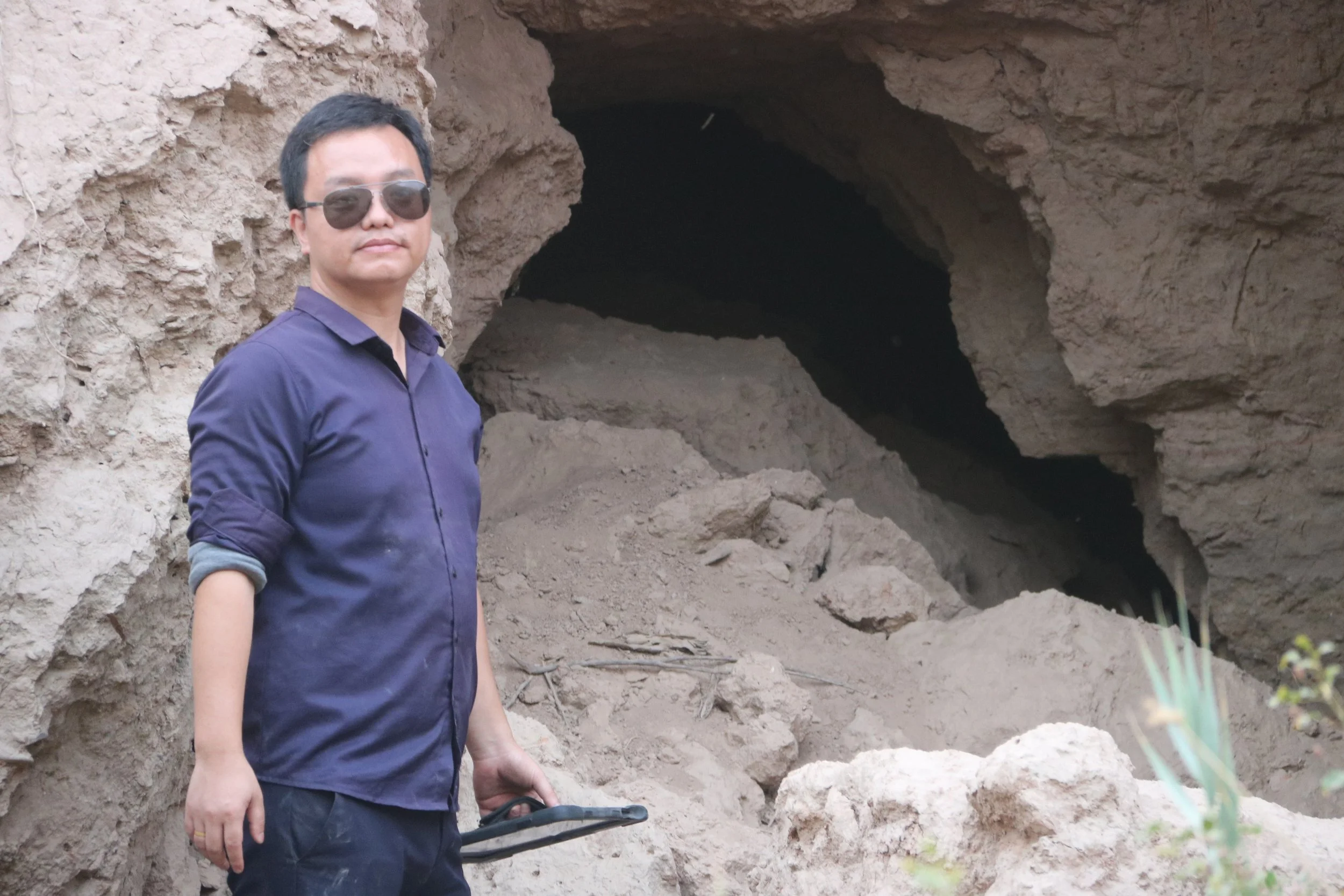
In our paper, “skylights” refer to openings on the surface that connect down into larger underground cavities. On Earth, and probably on Mars as well, such skylights are often the surface expression of lava tubes or cave systems.
These can form in several different ways. One is from collapsed lava tubes. When lava flows, it can form a hollow “tube” with a solid roof. If parts of the roof later collapse, they leave a hole at the surface while most of the tube remains as an underground cavity.
They can also form via karst-like collapse by water. If the subsurface contains layers rich in soluble minerals, such as carbonates or sulfates, and liquid water or saline brines circulate through them over long timescales, they can dissolve the rock and create voids. Eventually, the overlying material becomes unstable and collapses, forming a skylight above a larger cave.
Some skylights could also just be gravitational collapse structures or collapses triggered by nearby impacts, without a well-developed underground cave system.
In our work, we were especially interested in whether the Hebrus Valles skylights could really be karst-like features carved and modified by water, rather than just normal lava-related pits or simple collapse craters.
Why did you focus your study on the Hebrus Valles region in particular?
We chose the Hebrus Valles region for several reasons. First, it represents a “sweet spot” in the Martian environment. Hebrus Valles is located at mid-latitudes on Mars. It is easier to access than the polar regions, but still cold enough that subsurface ice can be preserved.
It also has very suggestive geomorphology. In particular, the area hosts deep valleys, layered deposits, and collapse structures that are, in many ways, reminiscent of karst landscapes on Earth.
In addition, Hebrus Valles is part of a long-standing debate. Previous studies disagreed about the nature of the materials there — whether they are mainly volcanic, sedimentary, or strongly modified by water. This makes Hebrus Valles a natural laboratory to test the “water-driven cave” hypothesis.
From an exploration perspective, if Hebrus Valles really hosts water-formed cave systems, it would be an extremely attractive target for future astrobiology missions and, eventually, for human exploration.
You combined several different types of imaging data to essentially map out these features and determine some of their mineralogy and chemistry. What was the most surprising thing you found?
We combined high-resolution imagery to look at shapes and textures, topography to analyze depth and slopes, and spectral data to identify minerals.
For me, the most surprising result was how consistent the story was across these different datasets. The skylights tend to occur within layered units that are rich in sulfates and carbonates — exactly the types of rocks that host many karst caves on Earth.
In addition, the surrounding walls and local structures show evidence of progressive collapse and “undercutting,” as if the subsurface has been gradually hollowed out, rather than simply destroyed by a single event.
And finally, the skylights’ geometries — including inward-sloping walls and partially collapsed roofs — look more like entrances into underground cavities than like normal impact craters.
In short, morphology, mineralogy, and structural context all independently point to the same conclusion. Namely, that these features were likely formed and modified by the long-term action of liquid water or brines in the subsurface.
You concluded that these skylights were formed by water, and therefore, "the first known potential karstic caves on Mars." What are the potential implications of these for past or present life on Mars?
If these skylights really are karstic caves formed by water, the implications for Martian life are quite significant in at least three ways.
First, they provide evidence for past habitable environments on Mars. To form karstic caves, you need liquid water or brines circulating underground over long periods of time. That means these caves could have provided relatively stable, protected micro-environments, even while surface conditions on Mars were becoming harsher. Microbial life, if it ever arose, might have survived or persisted in such sheltered niches.
They also provide “cold storage” and natural shelters for present-day life. Caves naturally shield against cosmic radiation, extreme temperature variations, and dust storms. Even if there is no liquid water today, ice, salts, and organic materials inside caves could be much better preserved there than on the open surface.
Finally, these are prime targets for astrobiology. Because skylights give relatively direct access to underground cavities, they are ideal focal points for future missions. If we want to maximize our chances of finding evidence of past or present life on Mars, these water-modified caves are among the most promising places to look.
To be clear, we are not claiming that we have found life. Instead, we are identifying environments where the conditions for habitability and preservation are particularly favorable, and where targeted exploration would be especially meaningful.
Are there any specific samples or analyses that would be the most useful for this targeted exploration, or do we need to go there and explore the caves ourselves?
In the long term, yes — the best way to fully test our ideas is to send missions to these skylights, and eventually to explore the caves directly. But before that, there are several important intermediate steps.
We need better orbital observations, including higher-resolution optical images and more targeted orbital radar observations to constrain the 3D geometry of the cavities and the surrounding layered deposits. Combining radar with gravity and thermal-inertia data will help us better infer rock types, porosity, and possible ice content.
We also need to conduct more terrestrial analog studies. On Earth, we are using similar radar and geophysical tools to study lava tubes and karst caves. By “practicing on Earth,” we can learn what genuine karst signatures look like in radar and imaging data, and what types of features might produce false positives when we interpret Martian data.
Future in situ missions will also help. An ideal mission architecture might involve a lander, a rover, and perhaps a small aerial drone. A rover or drone could approach a skylight, image the interior, measure gas composition, temperature, and mineralogy, and, if feasible, collect samples from the cave walls or floor.
So, in the end, we probably do need to go there, but improved orbital data and Earth analog studies can already help us narrow down the most promising targets and design safer, more efficient missions.
Is there anything else you’d like to discuss that I haven’t asked you about?
Since this Q&A is aimed at students and early-career researchers, I’d like to add two brief points.
First, cave science is naturally interdisciplinary. This work sits at the intersection of planetary geology, radar and remote-sensing technology, climate and hydrology, and astrobiology. You don’t have to label yourself as “only a geomorphologist” or “only a radar person.” Many of the most interesting questions appear when you combine tools and perspectives from different fields.
Second, the “underground worlds” of planets are a key frontier. Over the next few decades, exploration of the Moon and Mars will increasingly move from the surface into the subsurface: lava tubes, caves, buried ice layers, and ancient deposits. These environments are more likely to maintain stable, potentially habitable conditions and to offer natural shelters and resources for future astronauts. Developing new radar and geophysical techniques to “see through” planetary surfaces is therefore a very exciting area for long-term research.
If readers are interested in our broader work on lunar and Martian lava tubes, subsurface cavities, and radar methods, I’d be delighted to share more in the future.